

Jon Spector, CEO of The Conference Board
The Conference Board is a non-profit business research organization whose members include 1,600 companies, including nearly 50 percent of the Fortune 500. We are probably best known for publishing the Consumer Confidence Index, but that’s just the tip of the iceberg of the analysis and advice we deliver to our members, who include the CEOs of the Fortune 50. We also produce hundreds of conferences, seminars and webcasts annually, directed at business leaders in the US and around the world.
The Conference Board has 200 employees in their New York headquarters and 70 more in over 30 cities around the world, from Brussels to Beijing. Coordinating all of these people and activities can be a challenge, and for that we turned to VSee, equipping twelve conference rooms (nine in New York and one each in Brussels, Beijing and Hong Kong) with Sony EVI-D30 pan-tilt-zoom cameras and another 21 individual offices with VSee on the desktop. We use VSee for both scheduled meetings and the numerous ad-hoc conversations that take place during the day. The application sharing capability is especially useful in training remote staff and reviewing budgets.
Video turns out to be a valuable tool for making sure everyone is on the same page. As CEO Jon Spector relates, “We had a meeting with staff members from Atlanta, Washington DC, New York and London, with everyone on VSee except for the person from London. Afterwards, one of the folks from New York complained that it was much harder to get the person from London engaged in the discussion, because we couldn’t see him.”
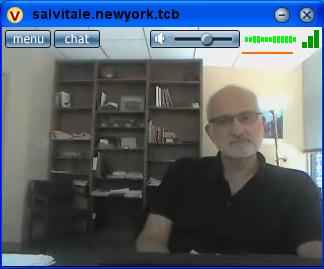 One of the more unusual applications of VSee is the live link that Jon Spector set up between his office in New York and his weekend home in Boston. When he is working in from Boston on Friday people can walk into his office in New York and see him live on the screen and talk to him in Boston. Such always-on video interactions would not be feasible without VSee’s ‘virtual office’ technology, comprising network management and user-interface components.
Contact:
Salvatore J. Vitale
Senior Vice President, Operations
The Conference Board, Inc.
845 Third Avenue
New York, NY 10022-6600
USA
+1 212 759 0900


Salvatore, does The Conference Board have its own VSee Directory Server? If so, do you also have the Relay and are you early adopters of the Relay & MCU server(s)?
That would be an interesting use case to share.
Rich, Are you simply interested in finding out who uses them and why, or are you looking into my specifically what functions do you get with these servers? Our mode of operation uses them (however still waiting on a beta version for the MCU Server).
I have a pretty good idea (based on the VSee product pages) what they do…I’m really interested in use cases. What were the decision criteria to self-host the Directory Server? Privacy? Or some activity / utililty unique to your needs that suggested self-hosting? I’m interested, in general, in how organizations and individuals use VSee and VSee services.
We are currently beta testing the whole process, but eventually we would like to think that the Directory Server (DS) can house up to 10k users. The DS has the ability to control each users access to specific features / functions such as; Quality of Video, Quality of Audio, App Sharing, USB Sharing, File Transfer, Recording. Our security team likes the “Single-Signon” (once authenticated, the VSee User / Call id cannot activate another session) process using our LDAP authentication process as well. Our own DS means that we are in control of the users, not VSee. So Privacy is certainly a priority. We had asked for and received additional functions to the DS that allowed us control of the call process. Specifically a logging process for both users and admins. Due to the very nature of our intra-communication process, although necessary at times, the Relay Server is not used much. Our Relay Server helps us traverse through sticky internal Firewalls that are not commonly setup. Let me know if you have any other questions.
Thanks, Mike, for the explication on the directory and relay servers. I would agree that the primary motivation for running one’s own Directory Server is the increased level of control that provides in provisioning users and regulating their activities.
VSee operates a public Relay Server which will automatically be used whenever a firewall or proxy server prevents two Vsee users from establishing a direct connection. A customer may want to install their own Relay Server if they want more control over how media is routed, for example to enable conversations between people who are on networks that are not otherwise bridged.